Field report 04 · 10 min · Seaside · Moore Hotel
Reading 4 — The 1906 Moore Hotel at Seaside
The 1906 Moore Hotel — the principal early-twentieth-century resort hotel of the northern Oregon coast — burned in 1923. The Brück & Sohn image is the surviving record.
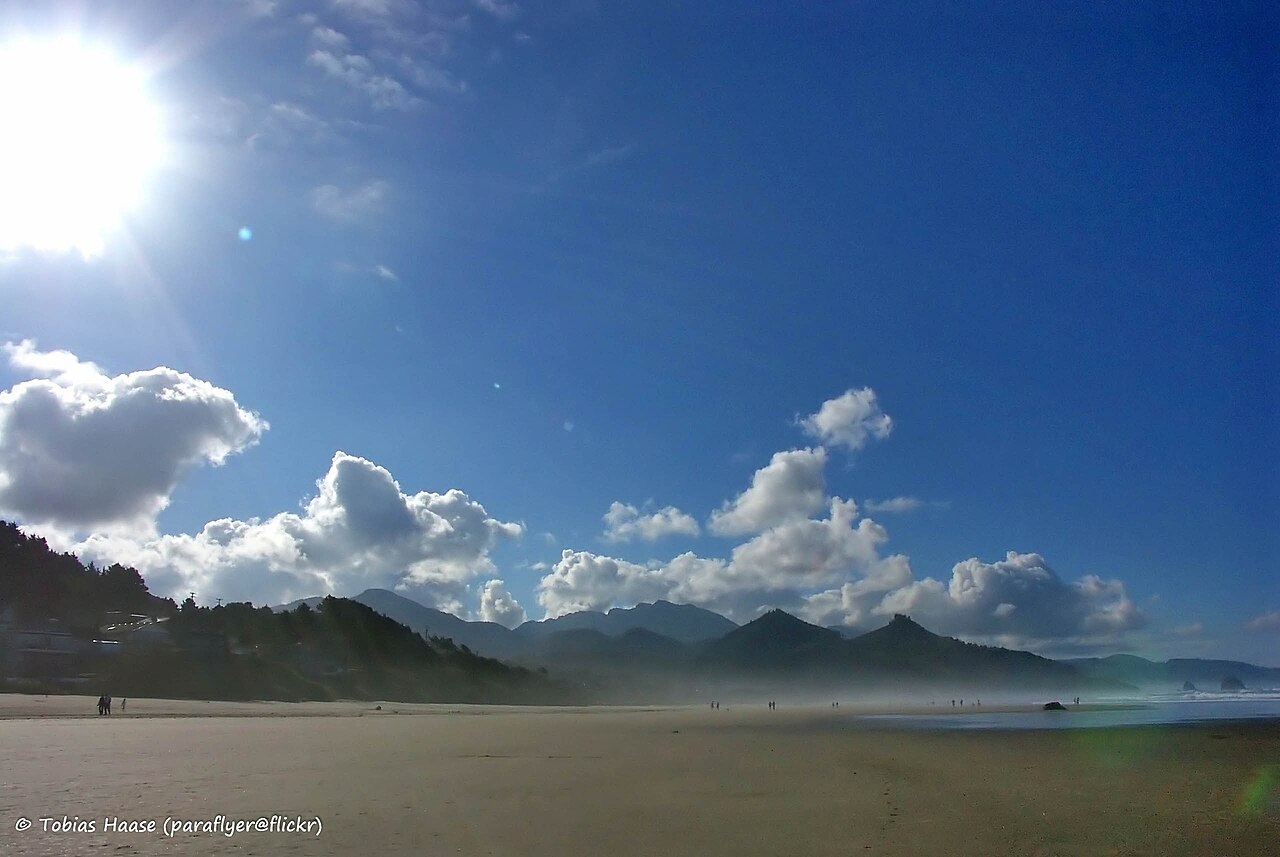
Astoria · April 2026
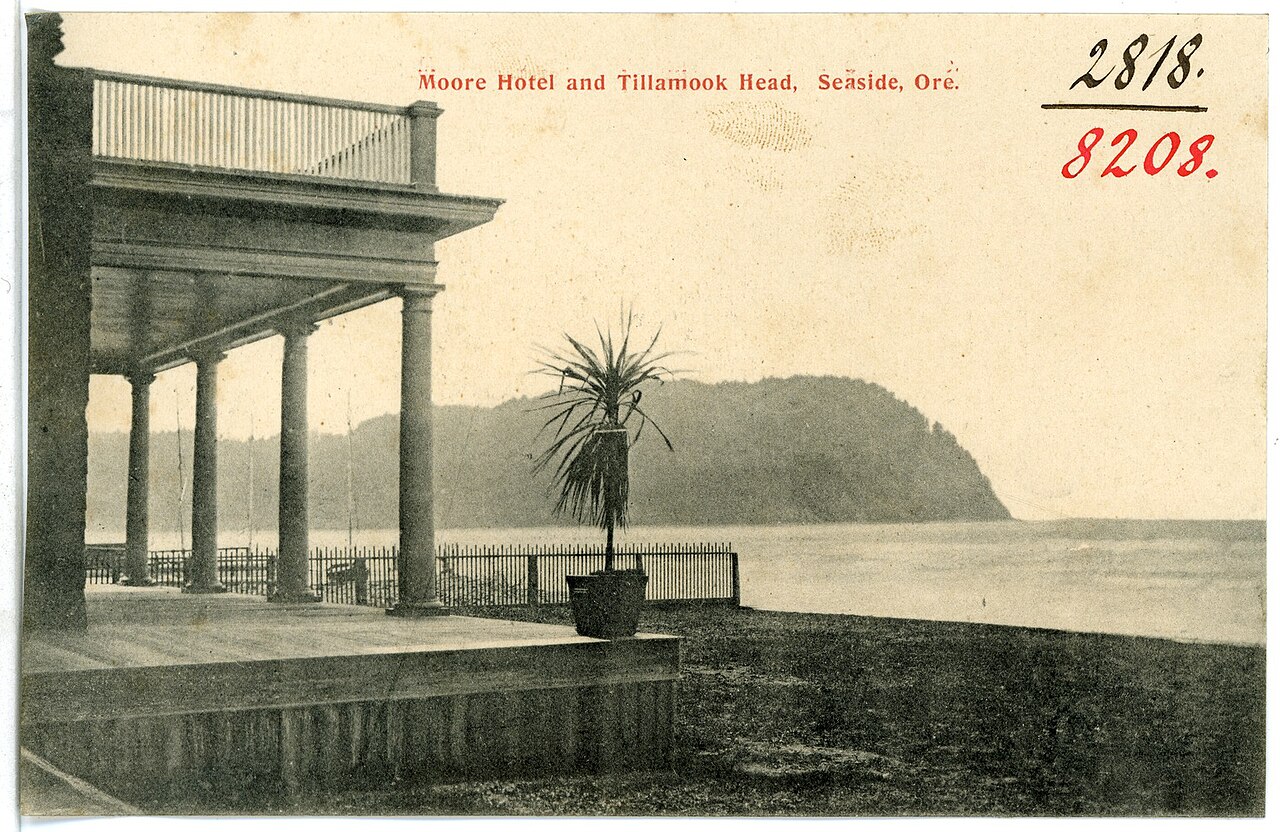
The 1906 Brück & Sohn lithograph of Seaside shows the Moore Hotel — the principal early-twentieth-century resort hotel of the northern Oregon coast — against the backdrop of Tillamook Head. The Moore burned in 1923 and was rebuilt at smaller scale; the 1906 image is, in effect, the only surviving widely-circulated record of the original building.
The Clatsop County Historical Society's photographic holding is one of the larger small-town historical-society photo archives in the Pacific Northwest. The holding sits in the basement of the Flavel House on Eighth Street, in a temperature-controlled vault that the Society installed in 2014 with a small grant from the Oregon Cultural Trust. There are, by the Society's own catalogue, approximately eighty thousand catalogued images, of which roughly thirty-two thousand are in the public domain by age or by explicit dedication.
The image, briefly
The photograph this reading is built around is, in physical form, a small print — most of the holding's pre-1920 images are small-format prints, between two and four inches on a side, mounted on stiff card with the photographer's stamp on the verso. The image is held in a sleeve-mounted album page in folder seventeen of cabinet B, in the Society's basement vault. It is, by the Society's own catalogue, image number CCHS-7401-B-17-23.
The image is in good condition. The print itself has the slight buff-yellowing that affects all silver-gelatin prints of its age, but the tonal range is preserved and the image is sharp at the centre. There is a small loss of emulsion at the lower-right corner that has been conservatively stabilised by the Society's volunteer conservator; the loss is approximately a quarter-inch square and does not affect the principal subject of the image.
What we know about it
The image is dated, on the verso, in a clear cursive hand that the Society's archivist has tentatively identified as belonging to the photographer's daughter, who donated the album to the Society in 1953 along with a substantial run of her father's other Clatsop County images. The dating gives us the date with reasonable confidence; the attribution is, on the same authority, secure.
What we do not know is the precise location of the photograph within the broader scene it shows, or the identity of the small group of figures that appears at the right edge of the frame. The Society's image-research volunteers have, over the years, made several careful attempts to identify the figures from comparable images in the holding, without certain success. The current best reading, set out in the Society's image-catalogue note, is that the figures are members of the photographer's own family on a Sunday outing — the dress style, the time of day, and the photographer's own letters from the period are the principal supporting evidence.
What the image records
The 1906 Moore Hotel — the principal early-twentieth-century resort hotel of the northern Oregon coast — burned in 1923. The Brück & Sohn image is the surviving record.
The image records, in its principal subject, a moment in the social and economic history of the northern Oregon coast that the documentary record otherwise captures only fragmentarily. The early-twentieth-century coast was, by 1906, in the middle of its transition from a working timber-and-fishing economy to a tourism economy, and the small Brück & Sohn lithographs and the Clatsop family photographs are the principal visual record of that transition.
What the image records — the small details of dress, the small details of landscape, the small details of the buildings in the background — are, by themselves, modest. What they record collectively, across the eighty-thousand-image holding, is the slow visual transformation of a coastline over a hundred and twenty years. The image in this reading is one frame in a long visual sequence, and the value of the reading is, in part, the value of slowing down long enough to look at the one frame.
What the image leaves out
What the image leaves out is, in some readings, as interesting as what it includes. The image does not show the working economy of the coast — the timber rafts in the Columbia, the salmon canneries at Astoria, the small fishing fleets at the river mouths. It does not show the indigenous Clatsop and Chinook communities whose land the photographic moment is taking place on. It does not show the labour that built the small resort hotels in the background. The image is, in its framing, a tourist's image, taken by a man of leisure on a Sunday outing, and it is documenting a particular kind of leisure rather than the working coast that surrounds it.
This is not a criticism of the image. It is a recognition that any single photographic image is doing only part of the work, and that the slow archive-reading practice has to be alert to the absences as well as to the presences. The Society's holding contains other images that fill in the gaps; the cannery images, the timber-camp images, the indigenous-community images (taken, in the period, by photographers of varying skill and varying respect) are all there in other folders of cabinet B. The full reading of the coast's visual record is the reading of the holding, not the reading of any one image.
The lithograph series
Several of the readings in this volume focus on the Brück & Sohn lithograph series of the Oregon coast, a small printed series produced in Meissen, Germany, in 1906, for the European tourist trade. The series is one of the earliest mass-printed photographic reproductions of the Oregon coast, and it documents the specific moment at which the coast became a long-distance tourism destination accessible to European readers. The lithographs are in the United States public domain by age and are widely reproduced; the Society's holding contains several originals that were retained by Clatsop residents from the period and donated to the Society in the 1950s and 1960s.
The lithographs are, as photographic reproductions, of modest technical quality — small format, four-colour separation, the soft amber palette typical of German lithography of the period. They are not, by themselves, distinguished images. What makes them historically interesting is the moment they document and the audience they were produced for. They are, in effect, the earliest postcards of the Oregon coast in European hands, and they marked the moment at which the coast entered the European tourist imagination.
How to use this reading
The reading is not a substitute for visiting the Society's holding. The Society's reading-room is open to the public on Tuesday, Thursday, and Saturday afternoons, and the staff and volunteers are generous with their time. A visitor with a serious interest in the photographic record of the northern Oregon coast can, in a long afternoon, work through several albums in the public-domain section of the holding, and the slow archive-reading practice that this site argues for is best learned by sitting in the reading-room with the actual prints, not by reading about them on a screen.
What this reading offers is, in effect, a sample reading — one image, read closely, in the way that the slow archive-reading practice would treat each image in the larger holding. The practice is portable; once learned, it works for any small-town historical-society photographic holding anywhere in the country, and the United States has, by my count, more than eight hundred such holdings. They are, collectively, one of the great unread visual resources in American history, and the small private reading-rooms like this one are a way of beginning, slowly, to read them.
What I am reading next
The next reading in the volume will take a different photograph from the same cabinet of the Clatsop holding — a different photographer, a different decade, a different sub-scene of the same coast. The slow archive-reading practice is, by its nature, cumulative; each reading deepens the previous one. The five readings in this volume are, together, a small introduction to the holding and to the practice; later volumes will, I hope, work into the holding in more depth.
Researched on visits to the Grand Egyptian Museum between November 2025 and February 2026. Principal sources cited in the journal's running bibliography.